The Lifecycle of an Organic SEO Campaign: From Foundation to Flywheel
In the world of digital marketing, “SEO” is often viewed as an either-or proposition. It is either seen as a magic “light switch” that immediately drives traffic or a dark art so complex that results are unpredictable. The reality is neither. SEO functions as a kinetic flywheel.
A flywheel is incredibly difficult to push when static. But every new piece of optimized content, technical fix, and quality backlink adds momentum. The most crucial moment—and where most campaigns fail—is the long, initial push before the momentum is visible.
If you are a business owner or marketing director, understanding this lifecycle is essential for setting expectations, measuring ROI, and surviving the inevitable “Valley of Disappointment.”
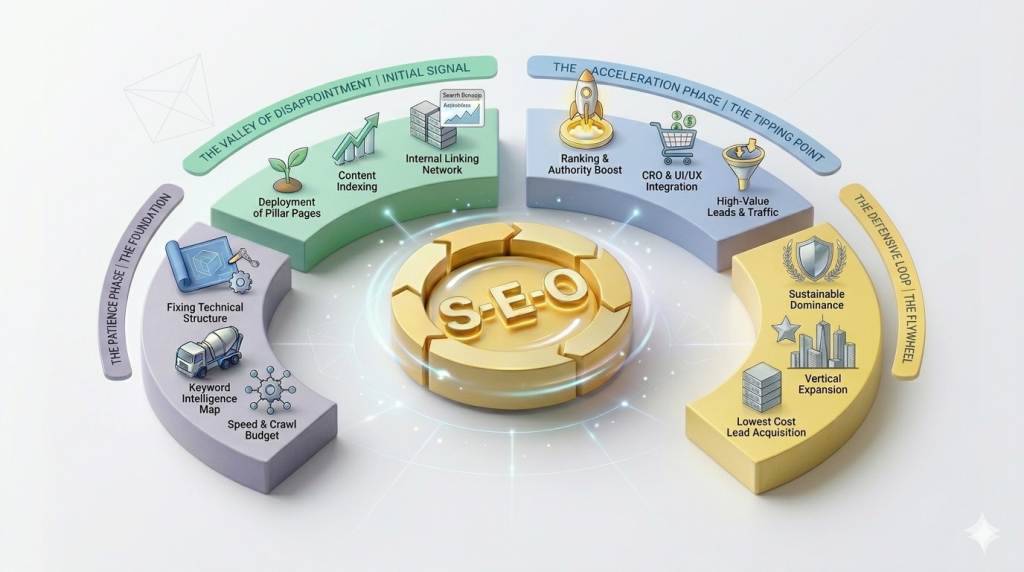
Phase 1: The Foundation (Months 1–2) — The Patience Phase
Think of this phase as building a high-performance engine. You have a blueprint, a goal, and a team of mechanics, but the vehicle is currently in pieces on the floor. This is the absolute peak of the “Patience Phase.” You are doing massive amounts of invisible, technical work based on infrastructure and trust, not content creation.
The Focus: Technical Audit & Architecture
Before you can rank, you must be trustworthy. Google will not show a slow, broken website to its users. We are:
- Fixing Technical Errors: Resolving 404s, redirect loops, and crawl errors that confuse search engines.
- Optimizing Crawl Budget: Making sure Googlebot is not wasting time on useless pages (like privacy policies) and instead focusing on your primary service pages.
- Structuring URLs: Moving from a chaotic directory to a clean, hierarchy-driven architecture that Google understands immediately.
- Keyword Intelligence (Not Volume): Mapping the “low-hanging fruit”—specific long-tail questions that indicate immediate buying intent, rather than just chasing high-volume “mountain peaks.”
The Metric that Matters (to the SEO): indexation rate and average Page Speed Index scores.
The Question the Client Asks: “Why isn’t my phone ringing?”
Phase 2: The Ascent (Months 3–6) — The Initial Signal
This is the tipping point where invisible work becomes visible. It is often the hardest part of the campaign: you are doing more visible work (publishing content), but the results only show up in technical reports, not in your inbox. This is the “Valley of Disappointment.”
The Focus: Structured Content & Initial Authority
This phase is about proving you are an authority on the technical foundation established in Phase 1.
- Content Deployment: Pushing high-value, research-driven pillar pages designed to capture specific long-tail searches.
- Internal Linking: The most underrated aspect of SEO. We use design and architecture to funnel “authority” from your new blog posts directly to primary conversion pages.
- Digital PR & Mentions: Moving beyond the basics to acquire authoritative mentions from industry-relevant blogs or local directories.
The Metric that Matters: A sharp increase in Google Search Console Impressions. Your site is being seen for relevant terms, even if you are on page 2 or 3 and not getting the click.
The Question the Client Asks: “I see we are getting impressions, but where are the customers?”
Phase 3: The Acceleration (Months 6–9) — The Tipping Point
The flywheel is moving. The authoritative base built over the previous six months now provides a foundation for everything you do. New content published today may start ranking for competitive terms within weeks, not months. Exponential returns have begun.
The Focus: CRO & Advanced Defense
Now that traffic is arriving, focus shifts from “finding visitors” to “converting customers.” This is where the integration of great UI/UX is paramount.
- CRO Integration: We analyze heatmaps. If traffic arrives at a blog post but bounces because the call-to-action is too small, we fix that UI friction. (See our guide on eliminating conversion friction).
- Content Freshness: We audit and update Phase 2 content, ensuring it remains the definitive resource.
- Competitor Gap Analysis: We dissect exactly why the “Top 3” competitors hold those spots, then create a strategy to leapfrog them.
The Metric that Matters: Organic Conversion Rate (Sales, Leads, or Signups) and lower bounce rates.
The Comment the Client Makes: “We are finally seeing some consistent leads!”
Phase 4: The Flywheel (Months 9+) — The Defensive Loop
The final phase is not about stopping; it is about converting your momentum into an insurmountable lead. You hold the high ground. The goal is to make it incredibly difficult and expensive for competitors to take those positions.
The Focus: Sustainable Dominance & Expansion
SEO has now become your lowest-cost acquisition channel.
- Vertical Expansion: Dominance in one niche allows you to expand into adjacent service keywords.
- Content Hubs: Grouping existing content into massive, authoritative guides that dominate broad “head” keywords.
- Scaling Production: Using the revenue generated from Phase 3 to fund high-velocity, premium content production.
The Final Metric: Traffic Value (how much this organic traffic would cost if acquired via PPC) and overall market share dominance.
Conclusion: Patience is a Strategic Asset
The critical takeaway from the SEO lifecycle is that the first six months are not about failure to rank; they are about building the capability to rank.
The most significant competitive advantage in digital marketing is patience. Most companies start an SEO campaign, get discouraged by the “Patience Phase,” and quit right as the initial signals appear. They surrender their flywheel right before it picks up speed.
By choosing to invest in the technical foundation first, you are not just hoping for a ranking boost—you are building a permanent asset that will provide compounding returns for years. The flywheel just needs its first, long, hard push.