
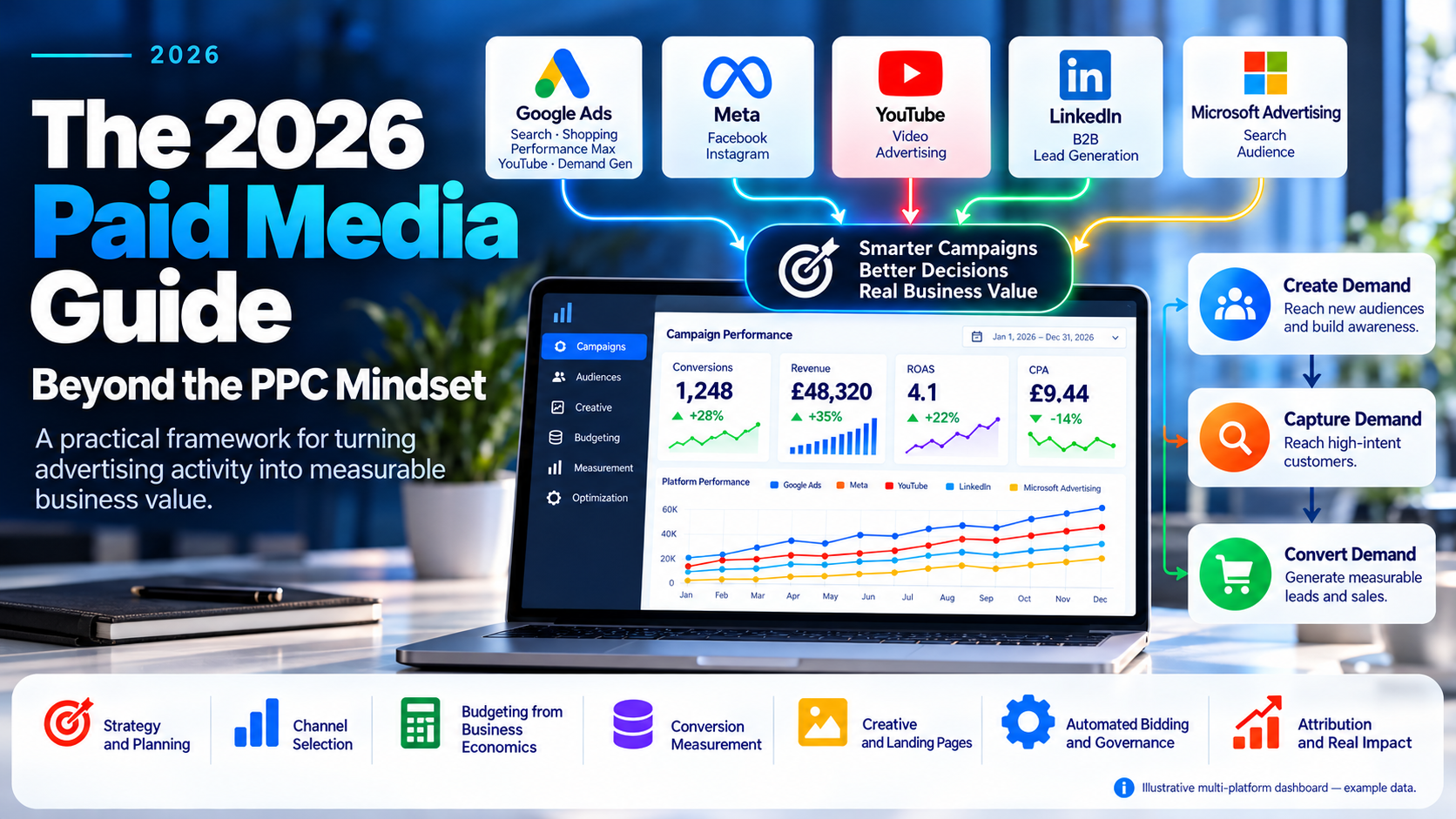
Paid advertising has changed considerably from the days when campaign management centred on choosing keywords, adjusting bids, and measuring how many people clicked an advertisement. Those activities still matter, but today’s advertising platforms combine automated bidding, audience signals, creative assets, and conversion measurement in ways that make successful campaign management a broader technical and commercial discipline.
In 2026, businesses can reach prospective customers through Google Search, YouTube, Microsoft Advertising, Meta, LinkedIn, and other paid channels. Each platform offers different methods of reaching people, measuring engagement, and optimizing campaigns toward business objectives.
Greater automation has not eliminated the need for advertising strategy. It has shifted more responsibility toward defining meaningful objectives, preparing accurate conversion data, understanding customer economics, testing creative approaches, and evaluating what advertising actually contributes to business performance.
A campaign can generate substantial traffic while producing few valuable enquiries. It can report an attractive return on ad spend while delivering limited profit. It can also influence demand that is not fully captured by its own conversion reporting.
Modern paid media management is not simply the process of buying attention. It is the coordinated planning, delivery, measurement, and improvement of advertising activity against clearly defined business goals.
1. Beyond the PPC Mindset: What Paid Media Means in 2026
Pay-per-click, commonly abbreviated as PPC, remains an important part of digital advertising. Businesses continue to purchase traffic through campaigns where clicks are the basis of the charge.
However, paid media encompasses a wider range of advertising approaches and billing models.
Advertisers may pay for clicks, impressions, video views, or other supported interactions. Some campaigns use automated bidding to optimize toward conversions or conversion value, even when the underlying billing model differs.
The distinction matters because the price of an individual click does not establish whether an advertising campaign is commercially successful.
From Buying Clicks to Managing Business Outcomes
Consider two campaigns targeting the same product or service.
One produces inexpensive clicks but attracts visitors who rarely purchase or submit qualified enquiries. The other produces more expensive traffic but reaches customers who generate substantially greater business value.
The second campaign may be the more effective investment despite its higher cost per click.
A modern advertising strategy therefore considers more than traffic acquisition:
- Business Objectives: The specific outcomes advertising should support, such as purchases, qualified enquiries, bookings, or customer acquisition.
- Audience and Intent: What prospective customers need, where they are in their decision-making process, and how they respond to different advertising environments.
- Creative and Messaging: The offer, images, video, copy, and landing-page experience presented to prospective customers.
- Conversion Measurement: How meaningful actions are recorded and connected with advertising activity.
- Commercial Economics: How acquisition costs compare with revenue, margins, and longer-term customer value.
- Performance Evaluation: Whether campaign results justify continued spending, refinement, or a different approach.
Automation Changes the Work, but Does Not Remove It
Google Ads Smart Bidding can use machine learning and auction-time signals to help optimize bids for conversions or conversion value.
Other advertising platforms also provide automated delivery, audience expansion, creative combinations, and budget optimization features.
However, automated systems work toward the objectives and signals supplied through the relevant campaign settings.
If a campaign is optimized toward a poorly defined conversion action, automation may become effective at generating the wrong result.
Similarly, an automated campaign does not independently know the true profit margin of a sale or the commercial value of a lead unless that information is supplied through suitable measurement and conversion-value processes.
Advertisers remain responsible for campaign objectives, appropriate conversion goals, budgets, creative quality, targeting controls, policy compliance, and commercial evaluation.
Google explains the underlying technology in its Smart Bidding documentation.
The objective is not to replace human judgment with automation. It is to use automation where appropriate while maintaining control over the decisions that determine business value.
2. Understanding Demand Creation, Capture, and Conversion
Customers rarely make every purchasing decision through a single interaction with one advertisement.
Someone may discover a product through video, compare alternatives in search results, return through a direct website visit, and purchase several days later.
For business-to-business services, the process may involve multiple stakeholders, research sessions, demonstrations, and sales conversations.
A useful paid media strategy considers three connected functions: creating demand, capturing existing demand, and converting interest into business value.
These functions are not rigid funnel stages. The same advertising channel may contribute to more than one, and customer journeys do not always follow a predictable sequence.
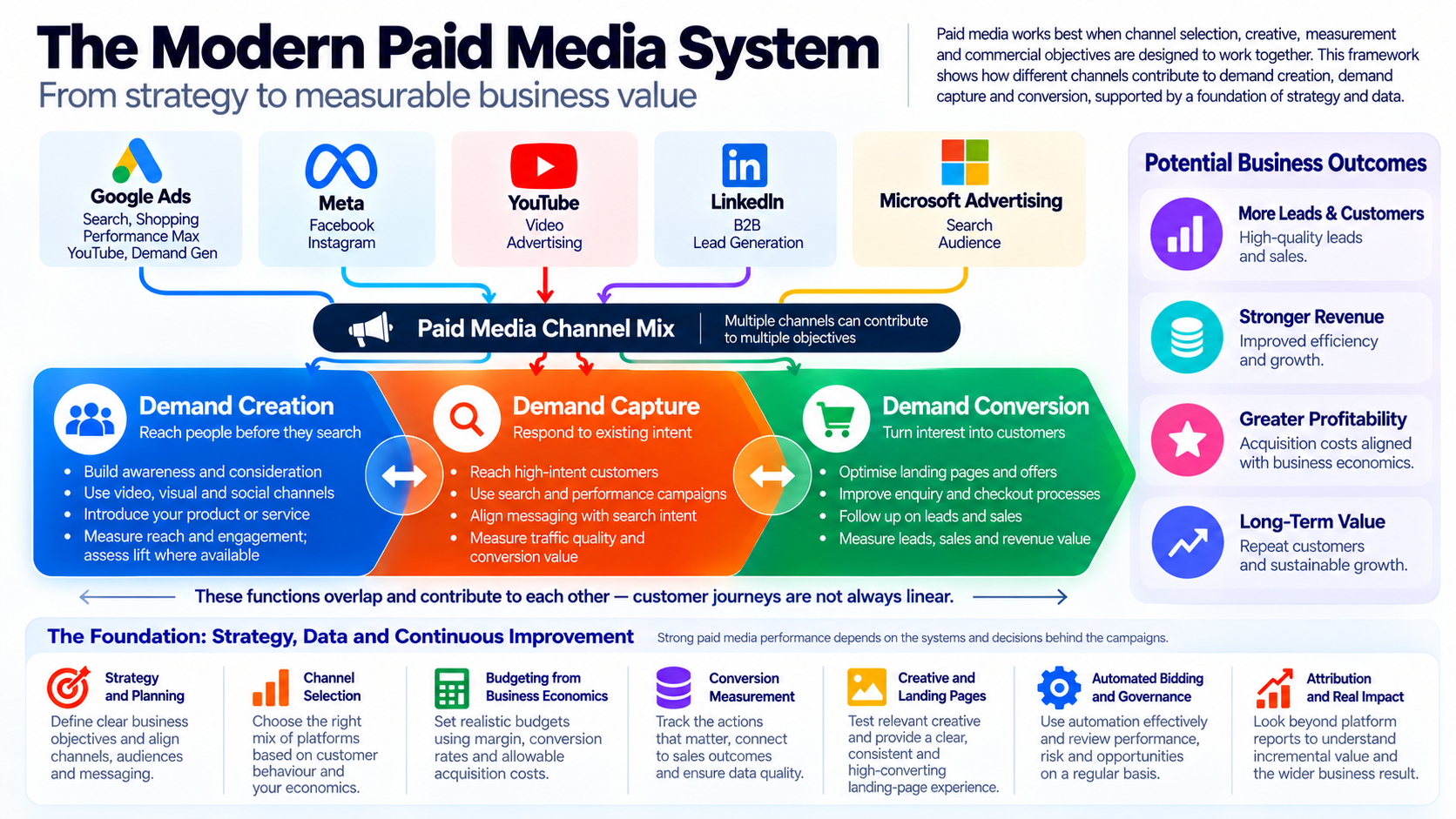
Modern paid media integrates multiple advertising channels across demand creation, demand capture, and conversion. These overlapping functions depend on strategic planning, business economics, reliable measurement, creative optimization, and continuous improvement.
Demand Creation: Reaching People Before They Search
Demand creation introduces a product, service, or business to people who may not currently be looking for it.
Video advertising, paid social campaigns, and suitable visual advertising formats can help demonstrate a problem, communicate a product’s benefits, or introduce a brand.
These campaigns may be appropriate for launching a new product, entering a market, explaining an unfamiliar service, or strengthening recognition among relevant audiences.
Useful diagnostic metrics may include:
- Reach and impressions.
- Frequency of exposure.
- Cost per thousand impressions (CPM).
- Video views and view-through rate, where applicable.
- Engagement with the advertisement or subsequent website content.
These measurements indicate delivery and interaction. They do not automatically demonstrate increased brand awareness, customer preference, or additional sales.
Where suitable experiments are available, brand lift, search lift, or conversion lift studies may provide stronger evidence of advertising impact.
Demand Capture: Responding to Existing Intent
Demand capture focuses on people already expressing relevant needs or commercial interest.
Search advertising is a common example. A person searching for a specific service, product category, or solution may be closer to taking action than someone encountering that subject for the first time.
However, not every commercial-looking search produces a qualified customer, and not all demand capture happens through search engines.
Useful campaign measurements include:
- Search term relevance and traffic quality.
- Click-through rate (CTR).
- Cost per click (CPC).
- Search impression share, where available.
- Landing-page engagement.
- Qualified leads, purchases, and acquisition costs.
CTR and impression share can reveal opportunities or delivery problems, but neither establishes whether customers are commercially valuable.
Demand Conversion: Making the Next Action Work
Demand conversion involves the website, landing page, enquiry process, checkout, or other experience where a customer takes the intended action.
Advertising can deliver relevant prospects, but a weak landing page or broken purchasing process may prevent those prospects from converting.
Conversion improvement may involve:
- Clear offers and relevant landing-page messaging.
- Fast, accessible website experiences.
- Transparent pricing and service information.
- Appropriate calls to action.
- Simple enquiry and checkout processes.
- Reliable conversion measurement.
- Follow-up procedures for leads that require a sales conversation.
Remarketing may also play a role in reconnecting with eligible audiences, subject to platform policies, consent requirements, and available audience data.
Demand creation, demand capture, and conversion should be planned together. Improving one part of the journey does not guarantee stronger business performance if another part remains ineffective.
3. Selecting Advertising Channels by Business Objective
Advertising platforms should be selected according to the opportunities they offer for a particular business, not simply because they are widely used.
A local service provider, an e-commerce retailer, and a specialist B2B consultancy may require very different combinations of channels.
Google Search and Microsoft Advertising
Search advertising is particularly useful when prospective customers express relevant needs through search queries.
Campaign planning should consider search intent, geographic coverage, keyword matching, exclusions, advertising copy, landing-page relevance, and conversion value.
Automated bidding can support campaign delivery, but advertisers still need to review search relevance, conversion goals, and commercial performance.
Google Performance Max
Performance Max is a goal-based Google Ads campaign type that can deliver advertising across multiple Google channels, including Search, YouTube, Display, Discover, Gmail, and Maps.
It combines automation with advertiser-provided conversion goals, creative assets, product data where relevant, and supported audience or campaign controls.
Its broader reach can be useful, but results should not automatically be interpreted as Search-only or Shopping-only performance.
Advertisers should evaluate available channel reporting, conversion quality, asset performance, and campaign settings before making allocation decisions.
For more detail, see Google’s Performance Max documentation.
YouTube, Demand Gen, and Paid Social
Video and visual advertising can communicate product benefits, demonstrate services, and introduce offers in contexts where users are not necessarily conducting an active search.
Google Demand Gen campaigns support advertising across eligible visual and entertainment-oriented Google surfaces.
In May 2026, Google announced that Display advertising would transition into Demand Gen, bringing Google Display Network inventory into the campaign type alongside eligible YouTube, Discover, Gmail, and other supported placements.
The phased migration tool began rolling out in June 2026, with the broader transition expected to continue into 2027. Advertisers can still run eligible Display-only activity through Demand Gen, but they should review migration requirements, channel controls, and changes to supported campaign features rather than assuming that every existing Display configuration transfers unchanged.
Google provides details in its Display to Demand Gen migration guidance.
Meta advertising can also support discovery, consideration, lead generation, and sales through suitable Facebook and Instagram placements.
These channels require attention to creative quality, audience relevance, measurement, and the difference between engagement and meaningful business outcomes.
A video receiving substantial attention may still produce little incremental commercial value. Conversely, an advertisement with modest engagement may contribute to a longer consideration process.
LinkedIn and Specialist B2B Advertising
LinkedIn can be appropriate when a business needs to reach professionals, organizations, or decision-makers using supported professional audience criteria.
However, the value of B2B advertising should be assessed against lead quality, sales qualification, close rates, and contract economics rather than form submissions alone.
High advertising costs can sometimes be commercially justified by valuable customer relationships, but those relationships must be measured rather than assumed.
The right channel mix depends on customer behavior, business economics, and reliable evidence. Being present on every platform is not a requirement for effective paid media management.
4. Engineering an Advertising Budget From Business Economics
Advertising budgets are frequently established through historical spending, competitor estimates, or an amount the business feels comfortable investing.
These considerations may influence the final budget, but a more useful starting point is to work backward from the value of the business outcomes the campaign is intended to produce.
The objective is not to generate a precise revenue forecast. It is to establish financial boundaries and determine whether the proposed acquisition strategy appears commercially feasible.
Step 1: Identify the Value of a Customer
For an online retailer, this may begin with average order value and the contribution remaining after product costs and relevant variable expenses.
For a service business, it may involve average contract value, expected contribution margin, sales conversion rates, and the cost of delivering the service.
Customer lifetime value may also be relevant when repeat purchases or renewals are supported by reliable historical data.
However, expected future revenue should not be used to justify unlimited acquisition spending.
Step 2: Establish an Allowable Acquisition Cost
Customer acquisition cost (CAC) compares the relevant acquisition expenditure with the number of customers acquired.
Businesses should distinguish this broader measure from platform-reported cost per conversion, which may include leads or other actions that do not result in new customers.
An allowable acquisition cost represents the amount a business is prepared to spend to acquire a customer while meeting its commercial objectives.
The calculation should account for the contribution available to cover advertising and the amount the business needs to retain.
Step 3: Build a Working Budget Scenario
Consider an illustrative e-commerce business with the following planning assumptions:
- Average Order Value: £120.
- Contribution Before Advertising: £45 per order, after product costs and the variable expenses included in the estimate.
- Desired Contribution After Advertising: £20 per order.
- Allowable Advertising Cost per Order: £25.
- Target Orders: 100 per month.
The allowable advertising cost is calculated by subtracting the desired contribution after advertising from the contribution available before advertising:
Allowable advertising cost per order = £45 contribution before advertising − £20 desired contribution after advertising = £25.
Under these assumptions, the maximum advertising expenditure consistent with the desired contribution is:
100 orders × £25 allowable advertising cost = £2,500.
The corresponding attributed revenue objective is:
100 orders × £120 average order value = £12,000.
This scenario produces £4,500 in contribution before advertising and £2,000 after deducting the assumed £2,500 advertising expenditure.
It does not establish final business profit. Fixed overhead and any expenses excluded from the contribution assumptions must still be considered.
This example calculates allowable advertising expenditure per order, not necessarily customer acquisition cost. Calculating CAC requires identifying newly acquired customers separately from orders placed by existing customers.
Step 4: Test the Traffic Requirements
Suppose the business assumes a 3% conversion rate from paid clicks to orders.
Approximately 3,334 paid clicks would be needed to generate 100 orders under that assumption.
With a £2,500 advertising budget, the implied average cost-per-click ceiling would be approximately £0.75.
This creates a useful feasibility question: can the business realistically attract sufficient relevant traffic at that cost while achieving the assumed conversion rate?
If market conditions suggest substantially higher click costs or a lower conversion rate, the business may need to improve the offer, revise its targets, test other channels, or reconsider the economics.
These figures are illustrative planning assumptions, not a forecast of attainable traffic or revenue.
Lead Generation Requires an Additional Calculation
For a business that acquires customers through enquiries, cost per lead and cost per customer are not equivalent.
Suppose a service business can afford a £300 customer acquisition cost and historically converts 20% of qualified leads into customers.
The corresponding allowable cost per qualified lead would be:
£300 allowable CAC × 20% lead-to-customer close rate = £60 per qualified lead.
This assumes the close rate and acquisition economics are representative of the leads generated by the proposed campaign.
If the campaign attracts lower-quality leads that close less frequently, its actual customer acquisition cost may exceed the target.
A useful advertising budget is connected to unit economics, conversion assumptions, and commercial objectives. Working backward exposes unrealistic expectations before they become expensive campaigns.
5. Building a Conversion Measurement Foundation
Advertising platforms optimize and report performance using the conversion information available to them.
When conversion tracking is incomplete, incorrectly configured, or focused on actions of little commercial value, performance reports can create a misleading picture.
Measurement should be designed around the customer actions that matter to the business, not simply around the events that are easiest to record.
Events and Key Events in Google Analytics 4
Google Analytics 4 uses an event-based measurement model.
Events can describe activities such as page views, product interactions, form submissions, and purchases when the appropriate measurement has been implemented.
Important events can be marked as key events in GA4.
However, marking an event as a key event does not automatically mean every advertising platform will use that event for campaign bidding.
Google Ads uses conversion actions and conversion goals to determine which outcomes are eligible for advertising optimization.
Conversions can be created from eligible GA4 events through the supported Google Ads and Analytics integration, but they must be configured appropriately for the campaigns concerned.
Google explains the distinction in its GA4 key events and conversions documentation.
Primary and Secondary Conversion Actions
Google Ads distinguishes between primary conversion actions used for relevant bidding goals and secondary actions generally retained for observation.
For example, an online retailer may want completed purchases to be the primary optimization objective while monitoring add-to-cart activity as a secondary diagnostic event.
A lead-generation business might track form submissions while also measuring which enquiries become qualified opportunities or paying customers.
Google Ads conversions created from Google Analytics events are generally configured as secondary conversion actions by default. Before using them for automated bidding, advertisers should review their action optimization settings in Google Ads and confirm that the intended campaign conversion goals include the appropriate actions.
Care is also needed to avoid counting the same purchase, enquiry, or other business outcome through multiple conversion actions used for bidding.
The precise configuration depends on the campaign’s selected conversion goals. Custom goals can introduce exceptions to the usual primary and secondary behavior.
Businesses should regularly verify which conversion actions are influencing automated bidding, especially after changes to analytics settings or account integrations.
For implementation details, see Google’s primary and secondary conversion actions guidance.
Connecting Advertising With Sales Outcomes
For businesses with offline sales processes, form submissions alone may not reveal which advertising campaigns attract commercially valuable prospects.
A suitable measurement process may connect advertising interactions with customer relationship management (CRM) records and subsequent sales outcomes.
Where supported and properly configured, enhanced conversions for leads and other approved conversion import methods can help Google Ads connect later customer outcomes with earlier advertising activity.
This requires appropriate data handling, accurate identifiers, suitable platform integration, and compliance with applicable privacy obligations.
For retailers, reliable purchase values, order identifiers, and controls against duplicate transactions are similarly important.
Consent and Privacy Are Part of Measurement Design
Advertising measurement must account for applicable privacy rules, user consent choices, and platform policies.
Google Consent Mode provides a way for supported tags to adjust their behavior according to the consent information they receive.
It does not replace the responsibility to obtain valid consent where required or make an otherwise non-compliant tracking implementation acceptable.
Likewise, server-side tagging or server-based conversion integrations are not universal solutions to lost measurement. They still require correct configuration, appropriate consent handling, and data-quality controls.
Google’s Consent Mode documentation explains the underlying principles.
Reliable measurement begins with meaningful conversion definitions, correct implementation, and responsible data handling. More tracking technology is not automatically better tracking.
6. Creative Strategy and Landing-Page Alignment
Creative assets have become especially important as advertising platforms increasingly automate parts of targeting, bidding, and distribution.
Images, video, headlines, offers, and calls to action influence which people respond to an advertisement and how they understand the business behind it.
In some automated campaign environments, creative performance can also influence delivery decisions.
However, it is inaccurate to describe creative as the only or universally dominant targeting mechanism.
Audience eligibility, campaign objectives, contextual signals, platform controls, conversion history, and advertising policies may all affect delivery.
Build Creative Around Specific Customer Questions
Useful advertisements communicate a relevant proposition rather than relying entirely on attention-grabbing language.
Depending on the product or service, creative may need to explain:
- What problem the product or service addresses.
- Who the offer is appropriate for.
- Which features or benefits distinguish it from alternatives.
- What the customer should expect from the purchase or enquiry process.
- Why the offer deserves consideration.
- What action the customer can take next.
Specific messaging can help prospective customers decide whether an offer is relevant. It may also reduce clicks from people who misunderstand the product or service.
However, specificity does not guarantee that an advertising algorithm will find more valuable customers.
Test Meaningful Creative Differences
A useful creative testing programme compares hypotheses rather than generating large numbers of nearly identical variations.
Possible tests include:
- A product demonstration versus a benefits-focused explanation.
- Different audience problems or use cases.
- Alternative opening statements for a video.
- A detailed technical proposition versus a simpler commercial benefit.
- Different calls to action.
- Different landing-page approaches for the same offer.
Creative results should be interpreted using appropriate measures of business value as well as engagement.
An advertisement with a high click-through rate may still perform poorly if its visitors rarely become customers.
The Landing Page Must Continue the Message
A campaign can create strong initial interest and still underperform when the destination page fails to support the advertised offer.
Landing-page reviews should examine:
- Consistency between advertising claims and page content.
- Clarity of the next action.
- Mobile usability and loading performance.
- Accessibility and readability.
- Form complexity and checkout friction.
- Transparent pricing, availability, and relevant policies.
- Measurement of important actions and errors.
Advertisers should avoid changing numerous creative and landing-page variables simultaneously when they need to understand the effect of an individual improvement.
Creative and landing-page optimization are connected responsibilities. An advertisement sets expectations; the destination experience must fulfil them.
7. Automated Bidding and Campaign Governance
Automated bidding can reduce the need for repeated manual bid adjustments, but it does not eliminate the need to manage advertising objectives and risk.
Google Ads provides Smart Bidding strategies designed to optimize conversion volume or conversion value.
Examples include:
- Maximize Conversions: Seeks conversion volume within the relevant budget and campaign constraints.
- Target CPA: Seeks conversions while working toward a specified cost-per-action objective.
- Maximize Conversion Value: Seeks greater reported conversion value within the relevant budget.
- Target ROAS: Seeks conversion value while working toward a specified return-on-ad-spend objective.
Google updated the presentation of some Smart Bidding strategy names beginning in June 2026. Advertisers may encounter interfaces that display Target CPA or Target ROAS as distinct strategies rather than as targets attached to their corresponding maximize strategies.
The June naming changes were primarily changes to how strategies are presented in the interface, rather than changes to the underlying bidding objectives.
Google also introduced a separate bidding-system update on 17 August 2026 affecting target-based strategies in campaigns marked Limited by budget. These campaigns are now intended to perform more consistently toward their specified CPA or ROAS targets, including when budgets are adjusted.
Advertisers whose budget-limited campaigns previously performed substantially better than their stated targets should review those targets against actual business requirements. For example, a campaign achieving a £5 CPA against a £10 Target CPA may begin delivering closer to the stated £10 target rather than maintaining its previous efficiency.
Google’s Bid Target Adjustment Tool can assist with reviewing and updating affected targets. Advertisers should evaluate whether to retain an existing target or revise it based on commercial goals and recent results, rather than assuming that the tool’s suggested changes are automatically appropriate.
Google explains the change in its August 2026 target-based bidding update.
Choose a Bidding Objective That Fits the Business
A business that values every valid conversion similarly may choose a different bidding approach from one where customer or transaction values vary substantially.
Value-based bidding can be useful when sufficiently reliable conversion values are available.
However, reported revenue is not the same as profit. If campaigns use purchase revenue as their conversion value, their bidding models do not automatically account for differing product margins or fulfilment costs.
Similarly, campaigns optimizing toward lead submissions may prioritize lead volume without necessarily accounting for differences in sales qualification or close rates.
Campaign objectives should therefore reflect the best available commercial information rather than convenient but weak proxy events.
A Higher ROAS Target Is Not Automatically Better
Increasing a Target ROAS objective asks the bidding system to pursue greater reported revenue efficiency.
However, a more restrictive target may reduce auction participation, conversion volume, or total conversion value.
Lowering a target can sometimes allow more competitive bidding and increased volume, although commercial efficiency may decline.
Advertisers should evaluate these trade-offs against margins, acquisition goals, budget availability, and historical performance.
Google discusses this relationship in its value-based bidding guidance.
Establish an Operating Review Cycle
Paid media management should include regular checks at different levels.
- Delivery and Account Health: Review rejected ads, policy issues, billing problems, conversion tracking failures, and unexpected spending.
- Traffic and Relevance: Evaluate search terms, audience responses, placements, and other supported delivery reports.
- Creative Performance: Identify useful differences between creative approaches without interpreting engagement as proof of commercial success.
- Conversion Quality: Check purchases, qualified leads, transaction values, duplicate events, and downstream sales outcomes.
- Commercial Performance: Compare acquisition costs and attributed revenue with appropriate profitability measures.
- Testing and Learning: Record major changes, allow for conversion delays, and evaluate results over suitable timeframes.
Review frequency should reflect budget, campaign volume, risk, conversion delays, and the amount of reliable performance data available.
Frequent adjustments to targets, conversion goals, or campaign structure can complicate interpretation and disrupt automated bidding while it adapts.
Good campaign governance does not mean changing settings constantly. It means knowing which controls matter, detecting genuine problems, and making justified improvements.
8. Attribution, Incrementality, and Measuring Real Impact
Advertising platforms report conversions according to their measurement configurations, attribution models, and available data.
These reports are valuable, but they do not necessarily show how many purchases or enquiries would have occurred without advertising.
That distinction is important when deciding whether to increase spending or change a channel’s role in the marketing strategy.
Attributed Conversions Are Not the Same as Incremental Conversions
An attributed conversion is an outcome that a reporting system associates with an advertising interaction according to its configured attribution rules.
An incremental conversion is an additional outcome generated because advertising occurred, compared with a relevant counterfactual in which that advertising did not occur.
For example, an existing customer might have purchased from a retailer even without seeing a remarketing advertisement. A platform may legitimately attribute that purchase to the advertisement under its reporting rules, but attribution alone does not prove that the advertisement caused the sale.
Controlled experiments, such as eligible conversion lift or geographic holdout studies, can provide stronger evidence about incremental advertising effects.
However, these studies are not available to every advertiser, and reliable experiments require suitable volume, design, and interpretation.
Google explains the distinction in its Conversion Lift reporting documentation.
Why Different Platforms Report Different Results
Google Ads, Google Analytics 4, Meta, LinkedIn, and a business’s own sales system may report different figures for the same general reporting period.
Differences can arise from:
- Attribution models and lookback windows.
- Click-based versus view-based attribution rules.
- Reporting dates and time zones.
- Consent choices and measurement limitations.
- Duplicate or missing conversion events.
- Refunds, cancellations, and transaction adjustments.
- Differences between attributed revenue and recorded business revenue.
These differences should be investigated, but they cannot always be resolved by expecting every platform to produce identical totals.
Reporting systems answer different questions and may use different methods to assign credit.
Measure the Wider Business Result
Campaign reporting should be connected with the wider commercial picture whenever appropriate.
For retailers, useful measurements may include:
- Attributed advertising revenue and ROAS.
- Customer acquisition cost.
- Gross margin and contribution after advertising.
- New versus returning customers, where reliably identified.
- Refunds and returns.
- Repeat purchasing and customer lifetime value, where supported by sufficient data.
For lead-generation businesses, useful measures may include:
- Cost per qualified lead.
- Qualification and sales acceptance rates.
- Lead-to-customer conversion rate.
- Customer acquisition cost.
- Contract value and contribution margin.
- Sales-cycle duration and delayed conversions.
A broader performance review may also examine total business revenue, overall marketing expenditure, and trends in acquisition efficiency.
These measures help place platform-reported results in context, but they do not independently establish causal impact.
Use Evidence to Make Allocation Decisions
When reallocating budget, consider both the reported performance and the likely incremental value of the investment.
A channel with a modest platform-reported ROAS may support valuable demand creation, while a channel with strong attribution results may capture customers who were already likely to convert.
Neither conclusion should be assumed without supporting evidence.
The appropriate response is to develop hypotheses, use suitable testing methods, and reassess spending against commercial results.
Attribution describes how credit is assigned. Incrementality investigates what advertising actually changed. Effective paid media strategy needs to understand the difference.
Conclusion: Building a Paid Media System That Can Be Measured and Improved
Paid media in 2026 is more sophisticated than buying clicks and monitoring the resulting traffic.
Advertising platforms combine automation, contextual signals, campaign objectives, creative assets, and conversion data to determine how advertising is delivered and evaluated.
That sophistication creates useful opportunities, but it does not remove uncertainty or guarantee profitable growth.
Businesses still need to understand their customers, establish financially sensible acquisition objectives, select suitable channels, prepare reliable measurement, and evaluate the value of the outcomes produced.
Creative testing, landing-page improvements, conversion quality, automated bidding controls, and attribution analysis should work together rather than operate as disconnected activities.
The starting point is a clear commercial objective. From there, advertising can be planned, tested, measured, and adjusted using the best available evidence.
Moving beyond the PPC mindset does not mean abandoning clicks, bids, or campaign metrics. It means placing those measures within a wider system of business strategy, responsible measurement, and ongoing improvement.