

A specialist business may need only a handful of new customers to generate substantial revenue. That makes advertising economics different from those of a high-volume retailer. A boutique architectural practice, fine art reproduction studio, or technical consultancy cannot evaluate paid media solely by clicks, form submissions, or the apparent affordability of an individual lead.
For a considered, high-value purchase, the useful question is not simply how much traffic a budget can buy. It is how much the business can afford to invest in acquiring a customer, given its inquiry rate, qualification process, sales cycle, delivery costs, and expected contribution margin.
High-ticket paid media should be planned backward from commercially worthwhile customer outcomes, then tested against what the market actually delivers.
The following calculations use hypothetical figures to explain that process. They are planning scenarios, not industry benchmarks or promised campaign results.
1. The High-Ticket Acquisition Budget Equation
Before selecting a monthly advertising budget, establish a realistic acquisition objective and estimate how many paid clicks could be needed to reach it. The first calculation connects the desired number of inquiries with the cost of attracting relevant visitors.
The Initial Media Budget Formula
Estimated paid clicks = Target inquiries ÷ Paid-click-to-inquiry rate
Estimated media spend = Estimated paid clicks × Average cost per click (CPC)
The rate must be written as a decimal in the calculation: 2% = 0.02.
A Practical $2,000 Example
Assume a specialist consultancy wants five eligible consultation inquiries per month, expects a 2% paid-click-to-inquiry rate, and models an $8 average CPC.
- Required paid clicks: 5 ÷ 0.02 = 250.
- Estimated monthly media spend: 250 × $8 = $2,000.
- Estimated advertising cost per inquiry: $2,000 ÷ 5 = $400.
That is an internally consistent starting estimate. It is not a guarantee that $2,000 will purchase exactly 250 useful visits or produce exactly five inquiries. CPC and inquiry rates change with competition, creative relevance, search mix, seasonality, device behavior, and landing-page performance. Low-volume campaigns are especially variable.
Use paid advertising clicks as the denominator when estimating paid-click-to-inquiry rate. A GA4 landing-page session conversion rate is not necessarily equivalent: recorded Google Ads clicks and analytics sessions can differ, and the inquiry definition must also remain consistent.
Translating the Monthly Estimate into a Campaign Budget
Google Ads generally uses an average daily budget for eligible campaigns. A $2,000 monthly planning amount corresponds to approximately $65.79 per day ($2,000 ÷ 30.4). Actual daily spend can vary, subject to the applicable spending limits and campaign budget settings. Google’s average daily budget documentation explains this distinction.
A modeled budget is useful only when search demand, available inventory, bidding strategy, and business capacity make the target plausible. If the market cannot supply sufficient relevant clicks, increasing the budget does not automatically create demand.
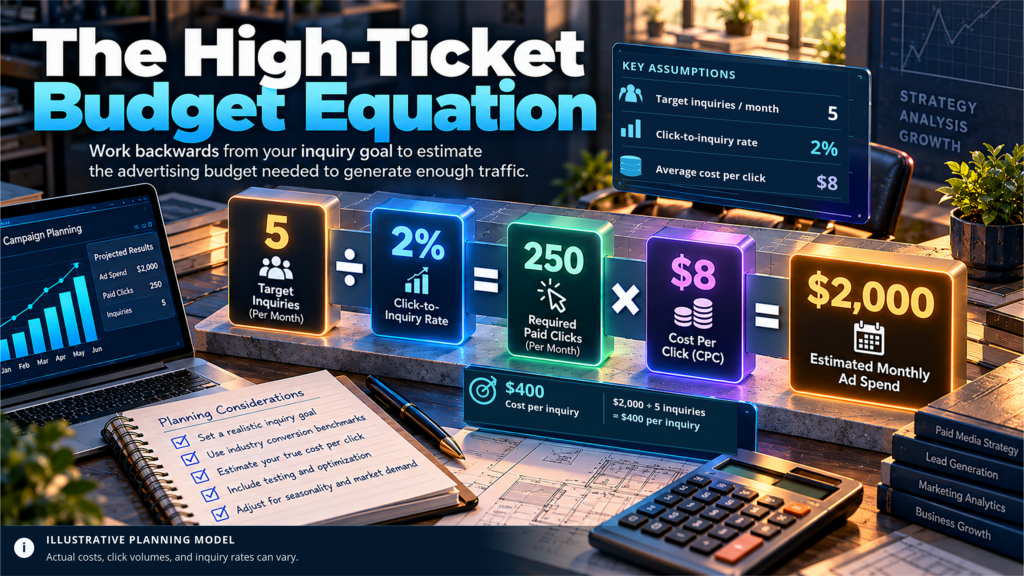
Working backward from five target inquiries, a 2% click-to-inquiry rate and $8 average CPC produce an estimated $2,000 monthly advertising budget, equivalent to $400 per inquiry. Figures are illustrative.
2. From Inquiry Cost to Profitable Customer Acquisition
The original budget equation answers a traffic-planning question. It does not establish whether the advertising investment will be profitable. For that, the model must continue beyond the inquiry form and into the business’s sales process.
Model the Stages After an Inquiry
Extend the same hypothetical consultancy example with two additional assumptions: 40% of inquiries become qualified leads, and 25% of qualified leads become customers.
- Five inquiries × 40% qualification rate = two qualified leads.
- Two qualified leads × 25% close rate = 0.5 expected customers per month.
- $2,000 monthly ad spend ÷ 0.5 expected customers = $4,000 advertising cost per customer.
The fractional outcome is a statistical expectation, not half a literal customer. Over a longer period, this model would imply approximately one customer for every two months of similar results. Actual timing could differ substantially, particularly where deals require consultations, proposals, approvals, or lengthy procurement processes.
The Downstream Acquisition Formula
Expected customers = Inquiries × Qualification rate × Qualified-lead close rate
Advertising cost per customer = Advertising spend ÷ Expected customers
This advertising-only figure is not a complete customer acquisition cost when sales labor, software, agency fees, or other acquisition expenses also apply.
Apply Revenue and Contribution Margin
Now assume that each won project generates $20,000 in revenue, with a 35% contribution margin before customer acquisition costs. The direct delivery and other variable costs included in that margin have already been deducted.
- Contribution before acquisition expenses per customer: $20,000 × 35% = $7,000.
- Estimated advertising cost per customer: $4,000.
- Other attributable acquisition expenses per customer (illustrative): $1,000.
- Total modeled acquisition cost per customer: $5,000.
- Remaining contribution per acquired customer: $7,000 − $5,000 = $2,000.
On these assumptions, the remaining contribution relative to modeled acquisition expenses is ($7,000 − $5,000) ÷ $5,000 = 40%. This is a contribution-based return on the acquisition spending included in the example, not a complete company-level ROI calculation: taxes, financing, unallocated overhead, contract timing, refunds, and any costs omitted from the model may change the outcome.
This distinction matters because return on ad spend (ROAS) typically compares attributed revenue with advertising expenditure, whereas a profitability assessment must consider the margin on that revenue and a defensible scope of costs. Google also emphasizes the importance of underlying profit and cost data in its ROI guidance.
For comparison, this hypothetical project produces 5× revenue-to-ad-spend ROAS ($20,000 revenue ÷ $4,000 advertising cost per acquired customer). That is different from the 40% contribution-based return calculated after accounting for the additional modeled acquisition expense. Revenue efficiency and contribution profitability should not be presented as the same measure.
Establish the Break-Even Boundary
If each new customer produces $7,000 in contribution before acquisition costs, then $7,000 is the maximum total acquisition spending that the modeled project can bear before its remaining contribution reaches zero. If other acquisition expenses consume $1,000, the corresponding break-even advertising allowance is $6,000 per customer.
Breaking even is not necessarily an acceptable business target. The company may require a larger buffer to cover unallocated overhead, cash-flow risk, sales variability, or its required profit. A sensible acquisition target should therefore be lower than the mathematical break-even ceiling.
3. Sensitivity Analysis: When the Budget Assumptions Change
Campaign economics are highly sensitive to small changes in acquisition cost and conversion rate. The table below holds the objective at five inquiries and changes the modeled CPC or paid-click-to-inquiry rate.
| Scenario | CPC | Click-to-inquiry rate | Modeled clicks for 5 inquiries | Estimated media spend |
|---|---|---|---|---|
| Baseline | $8 | 2% | 250 | $2,000 |
| Higher CPC | $10 | 2% | 250 | $2,500 |
| Lower inquiry rate | $8 | 1.5% | ≈333.3 | ≈$2,666.67 |
| Both pressures | $10 | 1.5% | ≈333.3 | ≈$3,333.33 |
The final scenario would require approximately 67% more media spend than the $2,000 baseline to pursue the same expected five-inquiry goal. This is a modeled relationship, not a prediction about market prices.
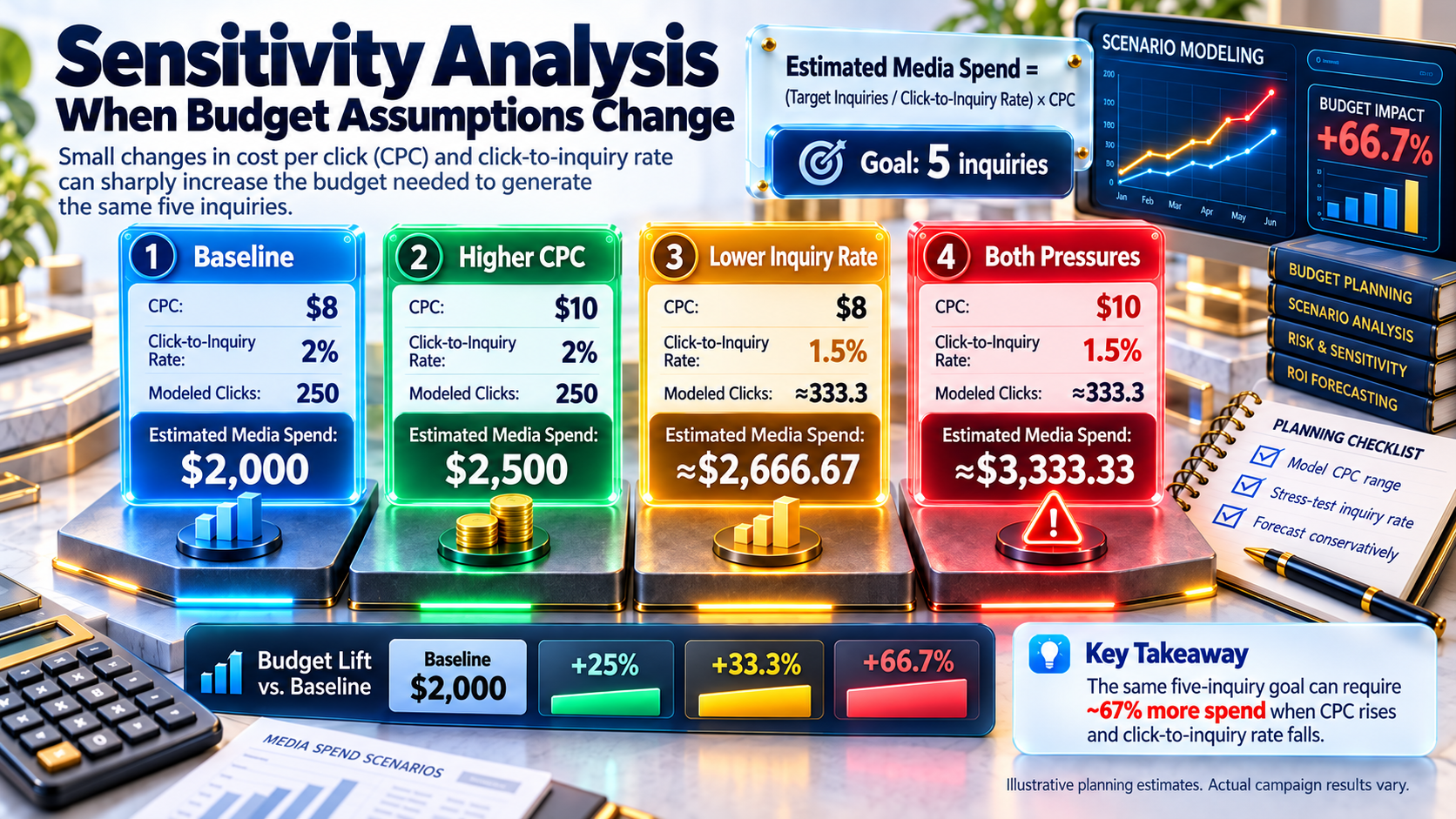
Small changes in cost per click and click-to-inquiry rate can significantly increase advertising costs. In this illustrative model, the same five-inquiry goal requires approximately 67% more media spend under less favorable conditions.
Stress-Test More Than CPC
Cost per click is only one variable. A meaningful forecast should also test changes in the qualification rate, close rate, average project contribution, and sales-cycle duration. When inquiry volume is small, the apparent results of a single month can be distorted by one unusually large contract or one lost opportunity.
A range-based forecast—conservative, baseline, and optimistic—offers a more useful decision framework than an exact-looking budget number unsupported by sufficient historical evidence. It also helps identify whether the business can absorb a period of advertising spend before sales revenue is realized.
4. Negative Keywords: Protecting Budget Without Excluding Valuable Demand
For a specialized service, irrelevant search queries can consume meaningful amounts of a limited budget. Negative keywords help prevent eligible ads from appearing for searches the business cannot satisfy. They should be selected from evidence, not applied as a universal list of undesirable words.
Review the Searches That Actually Trigger Advertisements
Google Ads’ search terms report can help identify queries that triggered ads, although it does not necessarily reveal every individual search. Review available terms alongside actual inquiry quality and conversion outcomes.
A specialist architecture practice, for example, may reasonably exclude clearly unrelated employment searches if it is advertising architectural services rather than recruiting. A premium consultancy might exclude searches for an unrelated software template or training course when neither is part of its offer.
But modifiers such as free, cost, pricing, or comparison are not automatically worthless. Someone seeking a free initial consultation or researching the cost of a complex project may be a legitimate prospect.
Account for Negative Keyword Match Behavior
Negative broad, phrase, and exact match types work differently, and negative keywords do not cover all the same close variants as positive keywords. Overly broad exclusions can also suppress legitimate demand. Google’s negative keyword documentation describes these limitations.
The practical process is to identify demonstrably irrelevant query themes, select the narrowest sensible exclusion scope, monitor the resulting traffic mix, and revise exclusions when the business’s services or campaign goals change.
5. Geographic and Audience Targeting for Specialized Markets
High-ticket advertising often serves geographically defined markets or small professional audiences. Relevance can improve when campaigns reflect where a provider operates and what prospective customers need. But platform audience signals should not be confused with verified financial capacity, professional credentials, or purchase intent.
Start with Serviceability, Not Assumed Wealth
For a location-dependent service, determine the actual geographic area in which projects can be delivered. A regional architect may have a narrower practical service area than a specialist consultant serving clients nationally or internationally.
In Google Ads, location options can include people in or regularly in selected locations and, with broader settings, people showing interest in those locations. Neither option perfectly identifies where a person is physically located. Review the campaign’s location settings and performance rather than assuming that a selected ZIP code or radius guarantees the composition of the audience. See Google’s advanced location targeting guidance.
Separate Search Intent from Audience Signals
A specific search query can indicate interest in an identified service, but it does not establish budget approval, authority to buy, or readiness to sign a contract. Audience observation and targeting capabilities also differ by campaign type. For eligible campaigns, Observation can help examine audience performance without necessarily restricting reach; a Targeting setting can narrow eligibility. Google’s targeting and observation documentation explains the distinction.
Demographic information, including estimated household income where available, should be treated cautiously. Estimated demographics are not proof of an individual’s resources, and excluding unknown demographic categories may unnecessarily reduce reach. Capabilities and policy limits also vary by location and advertising category.
Observe Advertising Policy Restrictions
Some advertising categories—such as housing, employment, and consumer finance in the United States and Canada—have additional restrictions on personalized targeting. For example, Google restricts certain demographic and ZIP-code targeting for relevant housing ads. Do not generalize an unrestricted luxury-services strategy to campaigns covered by special rules. Review the applicable personalized advertising policies before deployment.
The more reliable qualification process continues after the click: relevant service descriptions, eligibility details, appropriate inquiry questions, and a CRM stage that records whether the prospect matches the business’s actual requirements.
6. The Landing Page Is Part of the Acquisition Model
Even carefully selected paid traffic can underperform when the destination page fails to explain the service or makes an inquiry unnecessarily difficult. For a high-ticket sale, the landing page must support an informed decision—not merely push every visitor toward the shortest possible form.
Preserve the Advertising Promise
If an ad promotes an enterprise accessibility audit, a destination devoted to general website design forces the visitor to search for the promised service. A relevant page should explain what the audit includes, who it is suitable for, what evidence or deliverables the client receives, and how the engagement begins.
High-value buyers often need case studies, qualifications, examples of previous work, technical standards, or a clear explanation of scope before they are ready to speak with a provider. Unsupported claims about being the best or most innovative option contribute less than specific, credible evidence.
Balance Form Completion with Lead Qualification
Removing every question from an inquiry form might increase submissions while making it harder to distinguish suitable projects. Conversely, requiring too much detail before an initial conversation can discourage legitimate prospects. The correct balance depends on what the sales team actually needs at that stage.
In the financial model, this trade-off appears in two variables: the inquiry rate and the percentage of inquiries that become qualified leads. A page variation should be assessed against both, not only against the first recorded conversion event.
Check Technical Reliability and Accessibility
Slow content loading, broken mobile forms, layout shifts, inaccessible controls, and confusing errors can prevent a valuable inquiry. Analyze the complete path—from ad click to usable page content to successful submission—using suitable field performance data and functional testing. Good technical scores do not establish that the offer is persuasive, but technical failures can make even a strong offer inaccessible.
For deeper treatment of message match, paid-search landing-page UX, and measurement, see The 1-of-1 Conversion Loop: Syncing Paid Search with Bespoke UX.
7. Measure Qualified Outcomes, Not Just Platform Conversions
In a specialized service business, the recorded website conversion usually precedes the financially meaningful outcome. Google Analytics, advertising platforms, and the CRM can describe different stages of the same process. They should not be merged into a single undifferentiated conversion total.
Define Each Stage Consistently
- Paid click: A measurable interaction with the advertisement.
- Inquiry: An eligible form submission, consultation request, call, or other intended contact action.
- Qualified lead: A prospect meeting defined business suitability criteria.
- Sales opportunity: A qualified requirement entering a genuine proposal or sales process.
- Customer: A signed engagement, completed sale, or another consistently defined commercial milestone.
These stages should be documented and, where possible, connected through appropriate identifiers or integrations. Count duplicate form submissions and recurring contacts consistently, and record how the business handles reopened opportunities or multiple stakeholders.
Connect CRM Outcomes to Google Ads When Appropriate
Google Ads supports conversion goals for qualified leads and converted leads that use supported offline conversion data. These can help advertisers evaluate outcomes beyond the initial website event when the data quality, volume, consent, and integration are suitable. See Google’s qualified and converted lead guidance.
Before relying on any event for automated bidding, check which conversion actions are primary or secondary, how duplicates are managed, and whether the downstream event can be matched reliably. A form submission reported in GA4 does not by itself prove that a profitable customer has been acquired.
Use Financial Metrics with Precise Definitions
- Paid-click-to-inquiry rate: Eligible inquiries ÷ recorded paid clicks.
- Cost per inquiry: Advertising spend ÷ eligible inquiries.
- Qualification rate: Qualified leads ÷ eligible inquiries.
- Cost per qualified lead: Advertising spend ÷ qualified leads.
- Qualified-lead close rate: New customers ÷ qualified leads from the relevant cohort.
- Advertising cost per customer: Advertising spend ÷ attributed new customers, using a consistent attribution and time window.
- Contribution after acquisition costs: Customer revenue minus included delivery costs and acquisition expenses.
Paid clicks, analytics sessions, inquiries, and booked customers are not interchangeable denominators. Longer sales cycles introduce additional timing differences: a lead acquired this month may become a customer several months later. Cohort-based reporting can be more informative than comparing unrelated monthly totals.
For supporting measurement concepts, see The Advertising ROI Handbook.
8. Build a Repeatable Financial Review Process
An acquisition model should be updated as campaign evidence accumulates. It is a decision tool, not a fixed statement of what future traffic or customers will cost.
Begin with an Auditable Forecast
Document the source and date of every important assumption: expected CPC, inquiry rate, qualification rate, close rate, sales-cycle duration, revenue per customer, and contribution margin. Separate observed historical figures from estimates and clearly label hypothetical planning inputs.
Review Search Quality and Landing-Page Outcomes Together
Compare search themes, negative keyword decisions, geographic performance, message relevance, page usability, and the qualification of the resulting inquiries. An increase in inquiry volume is valuable only to the extent that it supports an acceptable customer acquisition outcome.
Change One Meaningful Assumption at a Time Where Practical
A specific landing-page test might ask whether adding a relevant technical case study improves the qualified-lead rate. A campaign test might examine whether a revised set of search themes reduces irrelevant inquiries without suppressing valuable demand.
Use appropriate testing methods when traffic permits, allow for the sales cycle and conversion delays, and avoid interpreting a small number of wins or losses as a stable trend. For low-volume high-ticket campaigns, qualitative review of inquiry suitability can complement the quantitative model without replacing consistent measurement.
The goal is not maximum clicks or minimum cost per form submission. It is a sustainable relationship between advertising investment, suitable opportunities, customers acquired, and the contribution those customers generate.
Conclusion: Engineer the Economics, Then Validate the Assumptions
High-ticket paid media requires more than a precise-looking budget formula. Search demand, cost per click, landing-page inquiry rates, lead qualification, closing performance, and contribution margin all influence whether advertising creates useful business value.
The initial $2,000 example is a valid traffic-planning calculation. Its commercial meaning only becomes clear when the model also includes customer acquisition and the economics of delivering the work.
A financially disciplined paid media program connects the cost of reaching a suitable prospect with the realistic value of converting that prospect into a customer—and continually tests that relationship against evidence.