
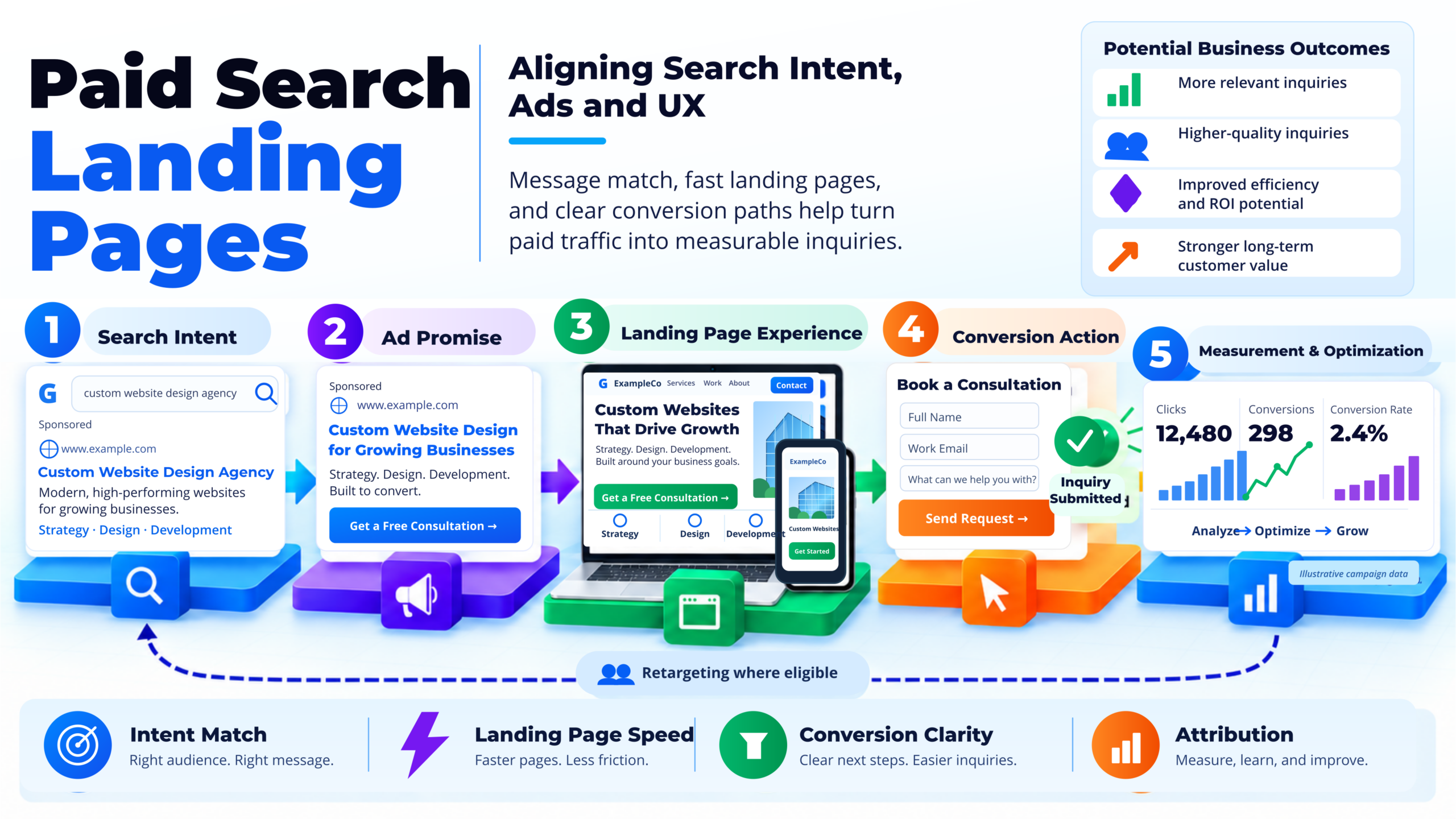
A successful paid search campaign does more than place an advertisement in front of someone looking for a product or service. It connects a specific search intention with a relevant offer, a convincing landing-page experience, and a clear next step. When those elements are disconnected, businesses can spend heavily on apparently qualified traffic without generating the commercial results they expected.
This problem becomes particularly important in specialist services and considered purchases. Someone searching for an enterprise website accessibility audit, a commercial architectural practice, or a technical consultancy may have very different requirements from a visitor browsing a general company website.
A relevant advertisement can attract their attention, but the destination page must help them determine whether the business can meet those requirements. Useful information, appropriate evidence, a reliable technical experience, and a suitable inquiry process all contribute to that decision.
That relationship between search intent, advertising, and user experience (UX) is sometimes described as message match. However, meaningful optimization extends beyond repeating an advertisement’s headline on a landing page.
It requires understanding the visitor’s needs, providing relevant evidence, reducing unnecessary friction, and measuring whether the resulting inquiries or purchases create real business value.
Effective paid search connects the promise made in an advertisement with an experience that helps the right visitor make an informed decision.
1. Message Match: Connecting Search Intent with Landing-Page Relevance
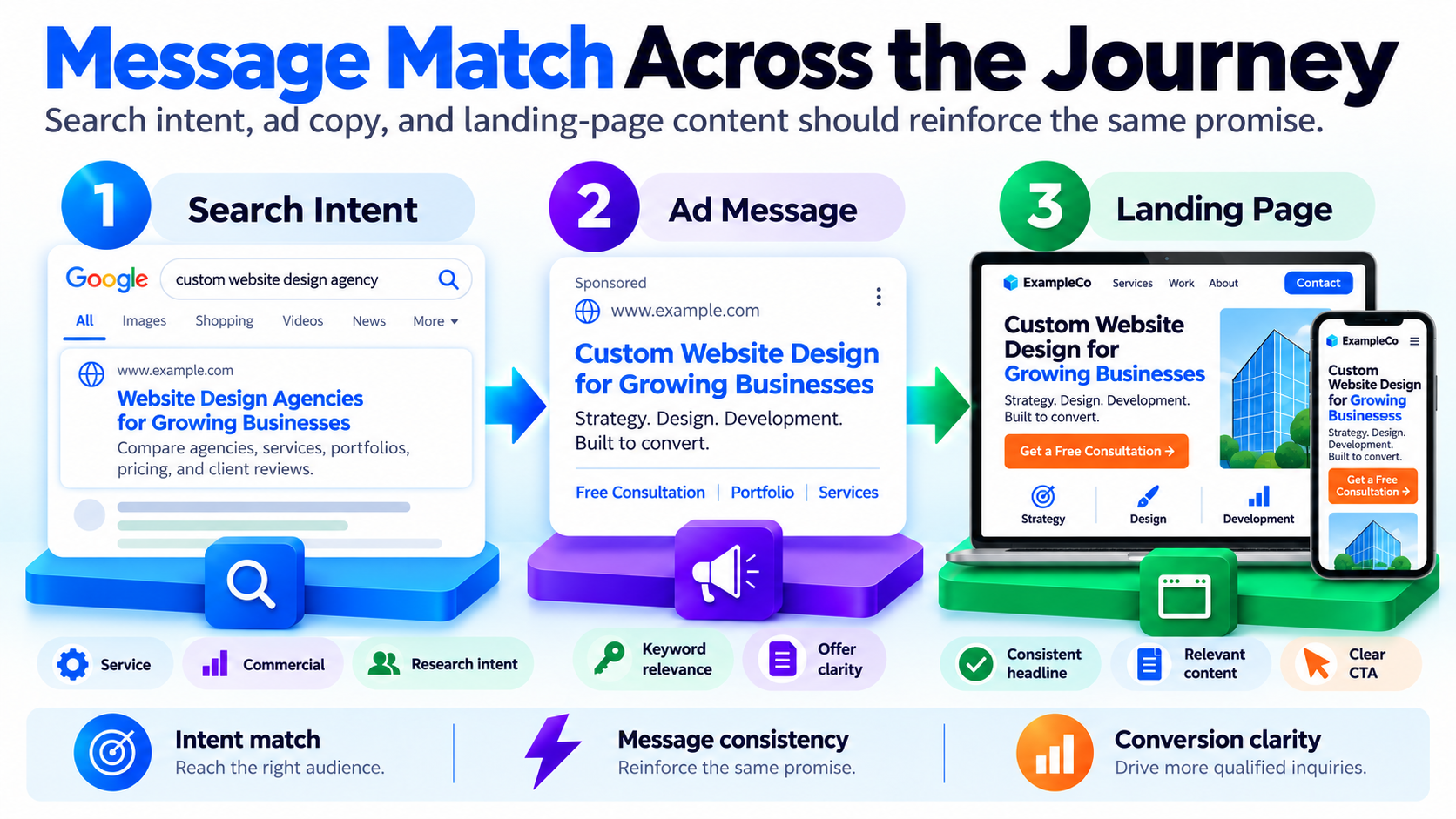
Message match describes the consistency between what a person is searching for, what an advertisement communicates, and what the destination page actually provides.
The objective is not to make every element visually identical. It is to preserve the meaning of the offer and make it easy for visitors to find what they were expecting.
The Three Parts of a Relevant Search Experience
A useful way to evaluate message match is to consider three connected elements:
- Search Intent: What does the person appear to need, and what information or service would satisfy that need?
- Advertising Promise: What does the advertisement say the business can provide?
- Landing-Page Experience: Does the destination explain that offer clearly and provide a suitable way to investigate or act on it?
Consider a prospective business customer searching for a specialist website accessibility audit.
If the advertisement explicitly offers website accessibility auditing, a general web design homepage may not be the most useful destination. The visitor would first need to find the relevant service, determine whether it includes the required assessment, and establish how to request a quote.
A more relevant landing page could explain the scope of the audit, applicable accessibility standards, the assessment methodology, reporting deliverables, and available consultation options.
The page may also provide suitable examples of previous work or explain the qualifications and experience of the people performing the assessment.
The important distinction is that the destination responds directly to the visitor’s question.
Relevance Matters More Than Exact Headline Repetition
Repeating a search keyword throughout a landing page does not necessarily improve its usefulness.
A page can have excellent message match while using natural language, explanatory headings, and supporting information that go beyond the original search.
Conversely, a page that repeats an advertisement’s exact wording but provides little substantive information may still disappoint visitors.
Google includes landing-page relevance and usefulness in its assessment of advertising quality. Its guidance also considers navigation, the clarity of information, and whether a destination meets the expectations created by an advertisement.
Google’s advertisement and landing-page optimization guidance explains the importance of maintaining consistency between search intent, advertising, and the destination experience.
Message Match and Google Ads Quality Score
For search campaigns, Google Ads provides a diagnostic Quality Score at the keyword level.
Quality Score considers expected click-through rate, ad relevance, and landing-page experience. The individual components can help advertisers identify where an advertisement or landing page may need attention.
However, Quality Score itself is not an auction-time input and should not be treated as the ultimate performance objective.
Improving a landing page may support advertising quality and conversion performance, but it does not guarantee a particular Quality Score, lower cost per click, or improved advertising return.
The more meaningful objective is to make the experience useful for prospective customers and evaluate its effect on qualified business outcomes.
A relevant landing page fulfills the advertisement’s promise, answers the visitor’s immediate questions, and makes the next action understandable.
2. Designing Landing Pages Around Search Intent
Not every paid search campaign needs a separate landing page for every keyword.
Creating hundreds of nearly identical pages can make maintenance difficult, produce inconsistent information, and create unnecessary duplication.
A better approach is to organize search themes into meaningful groups and determine which groups genuinely require different landing experiences.
Distinguish Research Intent from Commercial Intent
Two people searching within the same industry may be at different stages of their decision-making process.
One may be researching the available solutions. Another may be comparing providers. A third may already know what service they need and be ready to request a proposal.
These differences affect the information that may be most helpful.
- Research-Oriented Searches: Often benefit from explanations, methodologies, service comparisons, examples, and educational information.
- Provider-Comparison Searches: May require credentials, case studies, service scope, differentiators, and an explanation of how an engagement works.
- High-Intent Service Searches: Often benefit from direct service information, eligibility details, practical expectations, and a clear inquiry or booking option.
- Brand-Specific Searches: May be satisfied by an existing relevant service page or company page, particularly when the visitor is already familiar with the business.
Intent should be inferred from the search context and tested against actual customer behavior. Individual keywords do not reveal every visitor’s motivations.
Build Landing-Page Groups Around Meaningful Differences
A business offering several specialist services might develop different landing pages for substantially different needs.
For example, a digital consultancy could separate inquiries for:
- Enterprise website redesign and migration.
- Website accessibility assessments.
- Technical performance optimization.
- Analytics and conversion measurement implementations.
These services may share brand-level information and a consistent design system, but each has different buyer questions, evidence requirements, and conversion objectives.
A reusable component-based landing-page system can maintain consistency while allowing the content to be tailored appropriately.
When an Existing Service Page Is Sufficient
A dedicated campaign landing page is not automatically better than an existing website page.
If an established service page already provides relevant information, loads reliably, presents appropriate evidence, and gives visitors a clear next step, it may work well as the advertisement’s destination.
Businesses should compare the likely benefit of a new page against the development effort and ongoing maintenance it requires.
For smaller campaigns, improving one strong service page may be more practical than creating multiple custom variations.
Keep the Offer Consistent
Whether a campaign uses a new landing page or an existing service page, the core offer must remain consistent.
If an advertisement promises a specific consultation, assessment, starting price, timeframe, or promotional condition, the destination should accurately explain the same offer.
Claims made in advertisements should be supportable, and important qualifications should not be hidden or contradicted by the landing page.
Bespoke UX does not mean building a unique page for every search. It means adapting the experience where genuine differences in customer needs justify doing so.
3. Designing High-Value Landing Experiences That Build Confidence
For expensive services and considered purchases, conversion often depends on more than convenience.
Prospective customers may need to evaluate the provider’s competence, understand the proposed engagement, compare alternatives, or discuss requirements internally before making contact.
A landing page should support those decisions without overwhelming visitors with irrelevant information.
Start with a Clear Service Proposition
The introductory section should answer the visitor’s most immediate questions:
- What service or solution is being offered?
- Who is it intended for?
- What problem does it address?
- What does the engagement typically involve?
- What is the appropriate next step?
The page does not need to answer every technical question immediately. It should establish relevance and provide a clear path to more detailed information.
For a specialist consultancy, a specific explanation of the service is generally more informative than an unsupported claim about being innovative, world-class, or industry-leading.
Support Claims with Relevant Evidence
High-value buyers often need reassurance that a provider understands their situation and can deliver the proposed work.
Relevant evidence may include:
- Detailed case studies describing the problem, approach, and outcome.
- Professional qualifications or relevant experience.
- Examples of deliverables or working methods.
- Client testimonials used with appropriate permission.
- Explanations of technical standards or project requirements.
- Clear information about project stages, responsibilities, and support.
Case studies are most useful when they explain the actual work performed rather than presenting isolated performance percentages without context.
Results should not be presented as typical or guaranteed unless the evidence supports that claim.
Remove Friction Without Removing Necessary Qualification
Lengthy forms can discourage visitors, particularly when they request information that is not needed at the initial inquiry stage.
However, shortening every form is not necessarily the best conversion strategy.
A technical consultancy may need enough information to determine whether an inquiry is relevant. Removing all qualification questions could increase form submissions while reducing the proportion that are commercially useful.
A sensible approach is to ask only for information that supports the next step.
For an initial consultation, this might include contact details, the type of project, a brief description of the requirement, and an optional timeframe or budget range where genuinely relevant.
Further qualification can take place later in the sales process.
Alternative inquiry paths may also be helpful, including a consultation booking option, a suitable telephone contact, or a clearly structured request-for-proposal process.
The available options should reflect customer preferences and the resources available to respond.
Make the Call to Action Specific
A vague button such as “Submit” may communicate less than a service-specific action.
Depending on the offer, suitable alternatives might include:
- Request an Accessibility Audit.
- Discuss Your Project Requirements.
- Book a Technical Consultation.
- Request a Project Proposal.
The call to action should accurately describe what happens next. A button promising an immediate quote should not lead to an unrelated contact process.
Reducing friction is valuable only when the resulting experience still supports appropriate customer qualification and informed decision-making.
4. Technical Performance, Accessibility, and Mobile UX
Even a highly relevant landing page can struggle when it is slow, unstable, difficult to navigate, or unreliable on the device being used.
Technical performance influences whether visitors can access the information and complete the actions presented to them.
These problems can be particularly costly when every visit has been purchased through an advertising campaign.
Use Core Web Vitals as Practical Diagnostics
Google’s Core Web Vitals focus on three aspects of the real-world user experience:
- Largest Contentful Paint (LCP): Measures when the page’s main visible content is likely to have loaded. A good result is 2.5 seconds or less.
- Interaction to Next Paint (INP): Measures responsiveness to user interactions. A good result is 200 milliseconds or less.
- Cumulative Layout Shift (CLS): Measures unexpected visual movement. A good result is 0.1 or less.
These thresholds are evaluated using appropriate field data, typically at the 75th percentile, and should be considered separately for mobile and desktop.
Core Web Vitals do not measure every aspect of landing-page usability, but they provide useful evidence about loading, responsiveness, and visual stability.
Google explains the definitions and thresholds in its Core Web Vitals guidance.
Prioritize Problems That Affect the Conversion Journey
For a paid search landing page, useful technical checks include:
- Whether the main service proposition becomes visible promptly.
- Whether images and decorative assets delay essential content.
- Whether advertising and analytics scripts introduce unnecessary blocking work.
- Whether menus, accordions, forms, and booking interfaces respond promptly.
- Whether content shifts while images, fonts, and embedded components load.
- Whether inquiry forms function reliably across mobile browsers.
- Whether the page remains usable when non-essential scripts fail.
Improvements should be evaluated using actual performance data rather than assuming that every script or plugin has a significant effect.
A small tracking implementation may have little measurable impact, while an inefficient page component or third-party integration may cause substantial delay.
Accessibility Is Part of the Conversion Experience
Accessibility should not be treated as a separate visual enhancement.
Visitors may rely on keyboard navigation, screen readers, magnification, voice input, or other assistive technologies to understand and interact with a page.
Landing pages should provide accessible headings, sufficient contrast, meaningful link text, keyboard-operable controls, and properly labeled form fields.
Form errors should be understandable and recoverable, and essential information should not depend solely on color, animation, or visual positioning.
The W3C Web Accessibility Initiative’s guidance on form labels provides practical implementation principles.
Accessibility problems can prevent a conversion altogether, even when the advertising successfully reaches a relevant customer.
Investigate Behavior Rather Than Relying on Bounce Rate Alone
A high bounce rate does not automatically prove that a landing page failed to satisfy the visitor.
In Google Analytics 4, bounce rate is the percentage of sessions that are not classified as engaged sessions.
Under the default GA4 configuration, an engaged session lasts longer than 10 seconds, contains a key event, or includes at least two page or screen views. The engagement-time threshold can be adjusted in the property’s Google tag settings.
This means bounce rate should not be interpreted as a straightforward measure of whether someone disliked a page or immediately abandoned it.
Visitors may also find information, use an external contact method, or leave for reasons unrelated to page quality.
Review engagement measures alongside the actual conversion journey, technical errors, form completion, and lead quality.
Google explains the measurement in its GA4 engagement rate and bounce rate documentation.
Technical optimization should make the intended customer journey faster, more reliable, more accessible, and easier to complete—not simply improve a dashboard score.
5. Remarketing and the Longer Consideration Process
Many specialist services involve a longer research and purchasing process than a straightforward consumer transaction.
A prospective customer may review several providers, discuss options with colleagues, request internal approval, or return after receiving additional information.
Remarketing can support this process by reconnecting with eligible people who have previously interacted with a business.
However, remarketing should not be treated as a universal requirement or a guaranteed method of converting undecided visitors.
Develop a Relevant Follow-Up Message
Repeatedly displaying the same sales-focused advertisement may add little value to someone who is still evaluating a complex service.
A more useful follow-up may provide information that helps address unresolved questions.
Depending on the audience and campaign, this could include:
- A case study involving a similar project requirement.
- An explanation of the delivery methodology.
- A demonstration of the proposed solution.
- Information about technical standards or project responsibilities.
- A suitable invitation to discuss project scope.
The goal is to make subsequent communications relevant rather than simply increasing repetition.
Use Audience Data Only Where Appropriate
Google Ads supports audience segments based on eligible interactions with a business’s website or other supported properties.
Google Analytics audiences may also be shared with linked Google Ads accounts when the relevant integration and advertising personalization settings permit it.
However, audience availability depends on consent, platform eligibility, membership thresholds, data retention, supported campaign types, and other restrictions.
Not every visitor can or should be placed into a remarketing audience.
Google describes these capabilities in its audience data segment documentation.
Server-Side Tracking Does Not Remove Privacy Requirements
Server-side tagging and conversion integrations may help businesses manage parts of their measurement infrastructure, but they do not grant permission to track or target people who have declined applicable advertising consent.
Google Consent Mode communicates consent choices to supported Google tags and services; it does not replace the need to obtain consent where required.
Businesses must also comply with applicable data protection laws, advertising platform policies, and restrictions relating to sensitive information.
Google’s Consent Mode documentation explains how tag behavior responds to consent settings.
Consider Whether Remarketing Adds Value
An additional attributed conversion after a remarketing interaction does not necessarily establish that remarketing caused the sale or inquiry.
Where sufficient volume and suitable experimentation tools are available, controlled testing may provide stronger evidence of incremental impact.
Frequency, audience eligibility, creative relevance, and the cost of follow-up advertising should also inform decisions.
Remarketing should support an informed purchasing process while respecting user choices. The goal is useful follow-up, not indiscriminate repetition.
6. Connecting Landing-Page Conversions with Qualified Business Outcomes
A landing page’s reported conversion rate may look successful while the business receives few useful inquiries.
This is especially important for B2B companies and specialist service providers where a submitted form is only the beginning of a sales process.
Effective measurement should distinguish between an action completed on the website and a business outcome established later.
Define the Conversion Stages
A lead-generation business might measure the following stages:
- Paid Click: A person clicks a search advertisement.
- Landing-Page Inquiry: The visitor completes an eligible contact form or another intended inquiry action.
- Qualified Lead: The business determines that the inquiry meets defined suitability criteria.
- Sales Opportunity: A qualified inquiry progresses into a genuine commercial opportunity.
- New Customer: The opportunity becomes a completed sale or signed engagement.
These are business definitions rather than automatically available stages in Google Analytics.
The business needs a consistent method of recording them, typically through an appropriate customer relationship management (CRM) process.
Configure Google Analytics 4 and Google Ads Correctly
Google Analytics 4 records website activity through an event-based measurement model.
Important events can be marked as key events in Analytics.
However, an Analytics key event is not automatically an active bidding objective in Google Ads.
Google Ads uses conversion actions and conversion goals to determine which outcomes are reported and, where appropriately configured, used by automated bidding.
Conversion actions created from GA4 key events are generally secondary by default, so advertisers should verify their action optimization settings in Google Ads before relying on them for bidding.
Campaign goals should reflect the intended business result, and duplicate conversion actions should not unintentionally count the same inquiry more than once for optimization.
Google explains the integration in its guidance on creating Google Ads conversions from Analytics key events.
Connect Qualified Leads and Sales Outcomes
For businesses with a CRM or offline sales process, suitable conversion imports can help connect later qualification and customer outcomes to earlier advertising interactions.
Google Ads supports enhanced conversions for leads and other approved conversion integration methods, subject to implementation requirements and applicable policies.
In 2026, Google updated enhanced conversions settings and its API requirements for offline conversion uploads.
From June 15, 2026, new adopters of offline conversion uploads, including enhanced conversions for leads, are directed toward the Data Manager API rather than the legacy Google Ads API upload workflow.
Google restricted legacy offline conversion upload access for developer tokens without qualifying prior upload activity. Eligible existing integrations with the necessary legacy access may continue using the Google Ads API under Google’s transitional arrangements.
Businesses implementing or maintaining these connections should review current Data Manager API requirements, access eligibility, conversion action settings, and integration compatibility before changing an established workflow.
Google provides details in its enhanced conversions settings guidance and Google Ads API offline conversion documentation.
Importing qualified outcomes can improve the commercial usefulness of conversion reporting, but it requires accurate CRM data, appropriate consent and data handling, and a reliable method of matching supported events.
It does not produce a complete record of every customer interaction or prove the incremental effect of advertising.
Measure the Stages That Explain Performance
Useful measures may include:
- Paid-Click-to-Inquiry Rate: Deduplicated eligible inquiries divided by recorded paid advertising clicks. This differs from a landing-page session conversion rate, which uses measured sessions rather than advertising clicks as its denominator.
- Cost per Lead: Advertising expenditure divided by recorded leads.
- Lead Qualification Rate: Qualified leads divided by recorded leads.
- Cost per Qualified Lead: Advertising expenditure divided by qualified leads.
- Lead-to-Customer Close Rate: Newly acquired customers divided by the relevant lead population.
- Customer Acquisition Cost: Relevant acquisition expenditure divided by newly acquired customers, using a consistent definition of acquisition costs.
These measures reveal different parts of the process. They should not be treated as interchangeable.
In particular, Google Ads clicks and GA4 sessions do not necessarily match. Differences can arise from measurement availability, consent, session definitions, tagging behavior, and other implementation factors.
Advertisers should therefore define both the numerator and denominator before comparing conversion rates between platforms or reporting periods.
For a lead-generation campaign, the most valuable conversion is not necessarily the easiest website action to record. It is the outcome that most accurately represents progress toward acquiring a worthwhile customer.
7. Why a Higher Landing-Page Conversion Rate May Not Mean Better Results
Reducing form friction or changing a call to action can increase the number of inquiries recorded by a landing page.
However, that improvement may not translate into additional qualified leads or customers.
Consider two illustrative results for a specialist service campaign.
The comparison uses paid-click-to-inquiry rate, calculated from the number of paid advertising clicks rather than GA4 landing-page sessions.
Scenario A: Fewer Inquiries, Stronger Qualification
Assume the campaign produces:
- 1,000 paid clicks.
- $4,000 advertising expenditure.
- 60 recorded inquiries.
- 24 qualified leads.
- 6 new customers.
The resulting measures are:
- Click-to-Inquiry Rate: 60 ÷ 1,000 = 6%.
- Cost per Lead: $4,000 ÷ 60 = $66.67.
- Qualification Rate: 24 ÷ 60 = 40%.
- Cost per Qualified Lead: $4,000 ÷ 24 = $166.67.
- Qualified Lead Close Rate: 6 ÷ 24 = 25%.
- Advertising Cost per New Customer: $4,000 ÷ 6 = $666.67.
Scenario B: More Inquiries, Weaker Qualification
Now suppose the landing page is changed to make the inquiry form easier to complete.
For illustration, assume the same traffic volume and advertising expenditure, but a different set of downstream results:
- 1,000 paid clicks.
- $4,000 advertising expenditure.
- 100 recorded inquiries.
- 15 qualified leads.
- 3 new customers.
The revised measures become:
- Click-to-Inquiry Rate: 100 ÷ 1,000 = 10%.
- Cost per Lead: $4,000 ÷ 100 = $40.
- Qualification Rate: 15 ÷ 100 = 15%.
- Cost per Qualified Lead: $4,000 ÷ 15 = $266.67.
- Qualified Lead Close Rate: 3 ÷ 15 = 20%.
- Advertising Cost per New Customer: $4,000 ÷ 3 = $1,333.33.
In the second scenario, the paid-click-to-inquiry rate increases from 6% to 10%, and reported cost per lead falls.
However, the number of qualified leads decreases, and the advertising cost per new customer doubles.
The figures are illustrative, and the decline in qualification is not a proven consequence of shortening the form. It is a hypothetical example of why businesses need to evaluate downstream results.
The best landing-page variation depends on the commercial value of the resulting customers, the cost of qualifying inquiries, and the resources required to manage the sales process.
Where other acquisition expenses exist, they must also be included when calculating full customer acquisition cost.
Landing-page conversion rate is a useful measure, but it is not the final measure of commercial success.
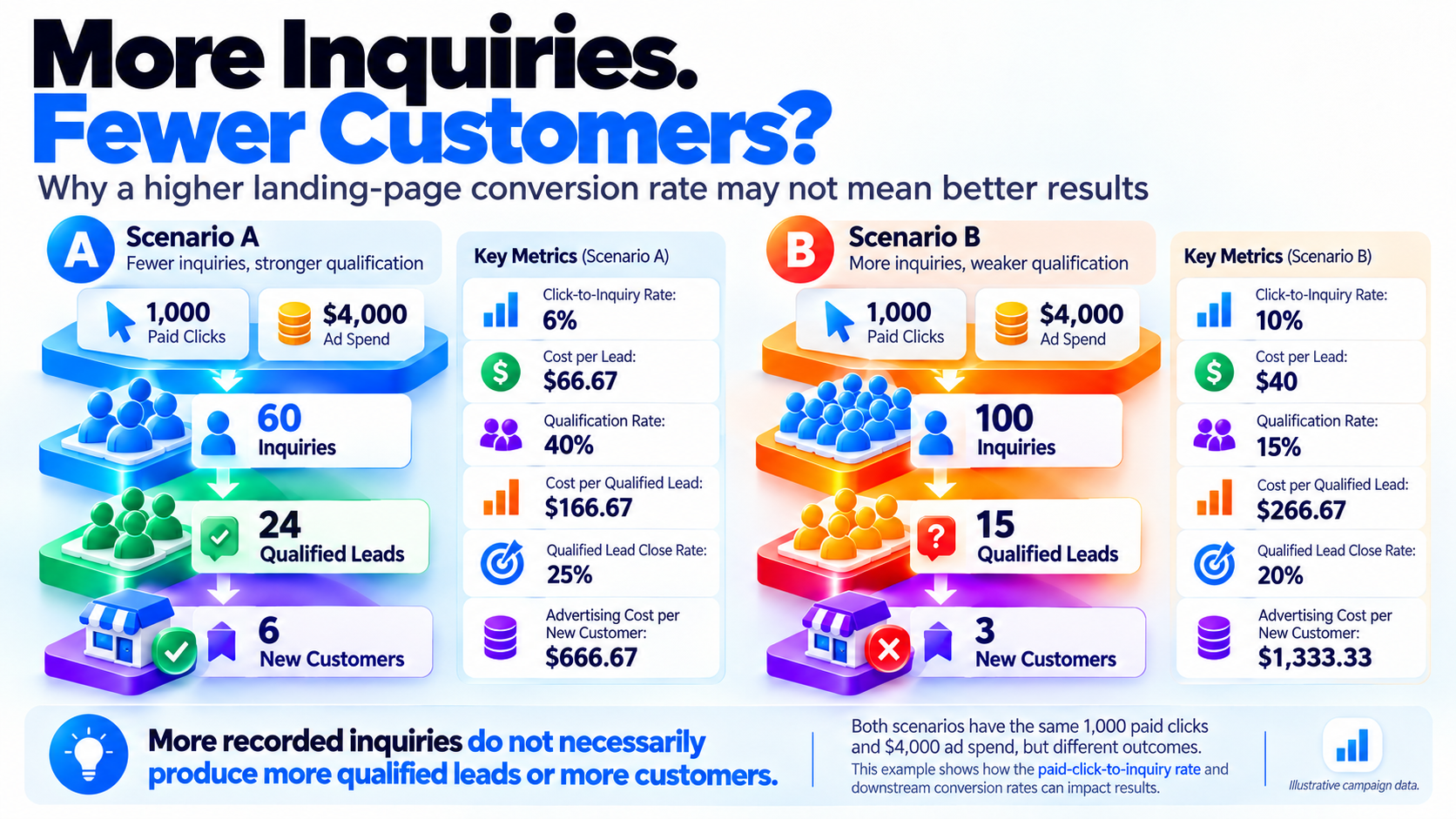
A higher click-to-inquiry rate does not necessarily produce better business outcomes. This illustrative comparison shows why qualified leads and customer acquisition matter more than inquiry volume alone.
8. Building a Repeatable Paid Search and UX Optimization Process
A useful paid search landing page should be treated as a measurable part of the customer acquisition process rather than a design project that ends when the page is published.
Improvement requires a repeatable method of identifying problems, proposing changes, testing them where practical, and examining the resulting business outcomes.
Step 1: Audit Search Intent and Advertising Promises
Review the search themes, available search term data, advertisement copy, and final URLs used by the campaign.
Identify cases where the destination page does not clearly fulfill the advertising promise or fails to address the likely purpose behind the search.
Prioritize meaningful mismatches rather than attempting to create individual pages for every keyword variation.
Step 2: Review the Landing Experience
Evaluate the page from the perspective of someone encountering the business for the first time.
Check whether the service proposition is understandable, the evidence is credible, important information can be found easily, and the next step is clear.
Test the page on mobile devices and with keyboard navigation, and review loading, layout stability, form behavior, and error handling.
Step 3: Verify Measurement
Check that relevant landing-page actions are recorded accurately and that conversion definitions are consistent between systems.
For lead-generation campaigns, review the connection between inquiries, qualified leads, sales opportunities, and customers where reliable data is available.
Confirm that the appropriate Google Ads conversion actions influence bidding and that consent settings and data-handling processes operate as intended.
Step 4: Create a Specific Test Hypothesis
Changes are easier to evaluate when they address a defined problem.
For example:
- Will a more specific service heading help visitors understand the offer?
- Will a relevant technical case study improve the proportion of qualified inquiries?
- Will simplifying a particular form field improve completion without reducing lead quality?
- Will improving mobile interaction performance reduce form abandonment?
- Will a clearer consultation description increase suitable bookings?
These are hypotheses, not guaranteed improvements.
Step 5: Test and Evaluate the Result
Where traffic volume and technical capabilities permit, use a suitable controlled experiment rather than comparing unrelated periods without accounting for other changes.
Google Ads provides experiments for supported campaign settings and landing-page changes. Other appropriate testing tools may also be used, depending on the implementation.
Google describes the approach in its Google Ads experiments documentation.
Evaluate results over a suitable period, allowing for conversion delays, low-volume uncertainty, and differences in lead qualification or sales outcomes.
A small increase in recorded inquiries may not justify a conclusion if the test has insufficient data.
Step 6: Retain What Works and Document What Was Learned
Implement changes supported by useful evidence, record the outcome, and continue reviewing performance.
Documenting test assumptions, dates, results, and relevant external changes can help prevent repeated mistakes and improve future decisions.
When campaigns have limited traffic, prioritize major usability problems and clear message mismatches rather than treating every small design difference as a formal experiment.
Continuous improvement is not constant redesign. It is a disciplined process of identifying meaningful problems, testing reasonable solutions, and measuring the outcomes that matter to the business.
Conclusion: Connecting Paid Search Intent with Meaningful Business Results
Paid search advertising creates opportunities to reach people who are already expressing an interest in a relevant product, service, or solution.
However, the value of that opportunity depends on what happens after the advertisement is clicked.
Visitors need to find information that matches their intentions, understand the offer, evaluate suitable evidence, and complete an appropriate next step without unnecessary difficulty.
For high-value services, the process may extend well beyond the landing page into lead qualification, consultation, proposal development, and customer acquisition.
That makes landing-page UX, technical performance, accessible design, conversion measurement, and sales processes connected responsibilities.
A campaign should not be judged solely by click-through rate, form completion, or platform-reported conversions. Those measures need to be considered alongside the quality and commercial value of the resulting customers.
The strongest relationship between paid search and UX is not perfect visual matching or maximum form submissions. It is a consistent, useful customer experience that connects advertising investment with measurable business outcomes.